
Last updated June 28, 2026
How to Hire a Garage Door Contractor in Los Angeles: A Step-by-Step Guide
In Los Angeles, a CSLB license number on a website tells you almost nothing about who will actually show up at your door. Large franchise operations and high-volume call centers dominate the local search results, and the technician they dispatch may have had as little as three weeks of on-the-job training before handling your springs, cables, and opener. The license got the company on-site — but the license doesn’t follow the individual. This guide gives you a concrete, step-by-step framework for vetting any garage door contractor before you book, so you know exactly who you’re hiring and what you’re agreeing to pay.
Quick Answer
To hire a legitimate garage door contractor in Los Angeles, verify a current CSLB C-61/D-28 license at cslb.ca.gov, confirm that the technician doing the work — not just the company — has relevant hands-on experience, and get a written estimate that itemizes parts, labor, spring type, and warranty terms before anyone touches your door. The difference between a good hire and a bad one in the LA market almost always comes down to who actually shows up, not who answered the phone.
Table of Contents
- Step 1: Verify the CSLB License in Under Two Minutes
- Step 2: Find Out If You’re Talking to the Technician or a Call Center
- Step 3: The Five Questions to Ask Before You Book
- Step 4: What a Legitimate Written Estimate Must Include
- Step 5: The “Free Estimate” Tactic — What It Really Means
- Step 6: Red Flags Specific to the Los Angeles Market
- Common Mistakes to Avoid
- When to Call a Professional
- Frequently Asked Questions
- The Bottom Line
Step 1: Verify the CSLB License in Under Two Minutes
California requires garage door contractors to hold a CSLB (Contractors State License Board) license under the C-61/D-28 classification — this is the specialty classification for doors, gates, and related hardware. A general contractor’s B-license or an unlicensed handyman operating under a homeowner exemption is not the same thing, and in Los Angeles you’ll encounter both presenting themselves as garage door specialists.
Here’s how to verify in under two minutes:
- Go to cslb.ca.gov and click “Check a License.”
- Enter the contractor’s business name or license number exactly as it appears on their website or invoice.
- Confirm that the license status reads “Active” — not expired, suspended, or revoked.
- Check the license classification: you want to see C-61/D-28 for garage door work specifically.
- Confirm that the business address on record matches what the company represents — out-of-state registrations with local phone overlays are a known pattern in LA’s high-volume service market.
A contractor who hesitates to give you their license number before you book is a contractor worth skipping. Any legitimate operator will hand it over immediately. At Noble Garage Door Repair Los Angeles, Daniel Martin’s CSLB credentials are verifiable — there’s no reason to hide documentation if the work is done right.
Step 2: Find Out If You’re Talking to the Technician or a Call Center
This is the single most underrated step in the hiring process, and it’s the one most homeowners skip entirely. In Los Angeles, some of the most heavily advertised garage door companies operate as dispatch hubs — their staff books appointments and collects payment, and whoever is available gets sent out. The technician who arrives may be a subcontractor working multiple companies, or a newer hire with limited hands-on time on the specific brands in your home.
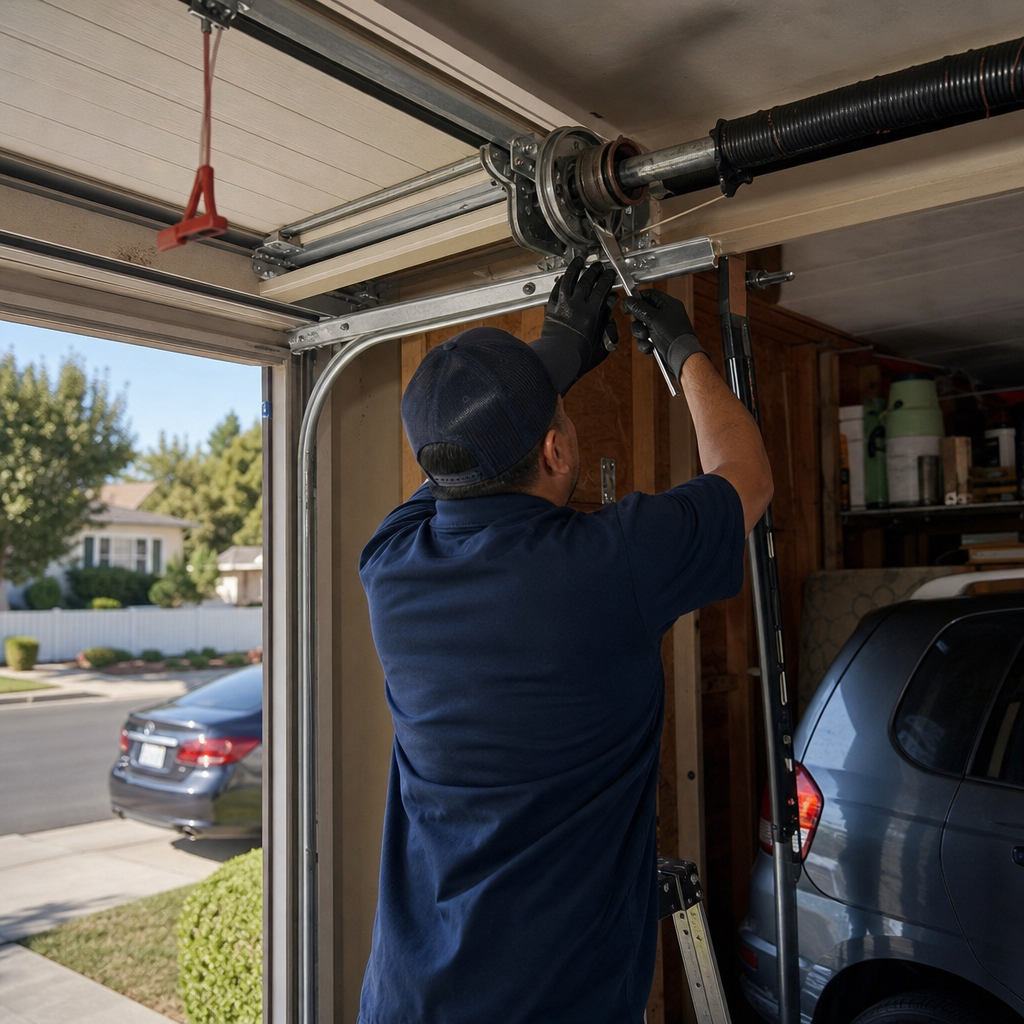
Owner-operated businesses work differently. When Daniel Martin at Noble Garage Door Repair answers the call, he’s also the technician who shows up, diagnoses the problem, and completes the repair. That means the person who hears your description of the problem is the same person pulling the springs and setting the tension — there’s no translation layer, no miscommunication between a dispatcher’s notes and a technician’s hands.
Why does this matter for price? Because a technician who owns the business has no incentive to upsell you on parts you don’t need. A subcontractor working on commission, or a technician evaluated by ticket value, does.
Ask directly: “Will the person I’m speaking with now be the technician doing the work?” The answer will tell you more than any online review.
Step 3: The Five Questions to Ask Before You Book
These five questions take less than five minutes on the phone and will immediately reveal whether you’re dealing with a specialist or a generalist dispatch operation.
- “How many years have you been working specifically on garage doors?” — You’re looking for dedicated, focused experience. A general handyman who added garage doors to their service list two years ago is not the same as someone who has spent 18 years exclusively on this equipment.
- “Are you factory-trained or certified on my brand?” — If you have a LiftMaster, Chamberlain, Genie, Clopay, Amarr, Wayne Dalton, Craftsman, or Raynor system, ask if they’ve been trained on it specifically. Brand-specific training means correct diagnosis and compatible parts the first visit — not a trial-and-error approach on your equipment.
- “Will you be the technician completing the repair, or will someone else be dispatched?” — As covered above, this separates owner-operators from dispatch centers.
- “Can you give me a written estimate before work begins?” — Any contractor who says pricing “depends on what we find when we get there” without giving you a range or structure is setting up an on-site upsell. A specific, itemized estimate can always be adjusted for unexpected findings — but a verbal ballpark followed by a dramatically higher on-site quote is a pattern worth recognizing.
- “What warranty do you provide on parts and labor?” — Get a specific answer: duration, what’s covered, what voids it. “We stand behind our work” is not a warranty term.
Step 4: What a Legitimate Written Estimate Must Include
A written estimate protects you and signals that the contractor runs a professional operation. In the Los Angeles garage door market, vague verbal quotes followed by higher on-site charges are one of the most common consumer complaints — and they’re almost always preventable with one document.
A legitimate written estimate for garage door work should include:
- Parts list with brand and specification — for springs, this means the spring type (torsion vs. extension), wire size, inside diameter, and length. For openers, the model number. Generic line items like “springs” or “cables” without specification are a red flag.
- Separate labor cost — labor and parts should be listed independently so you can compare against market rates.
- Warranty terms in writing — duration for both parts and labor, clearly stated.
- Total cost before any work begins — not a “starting from” figure.
- Contractor’s name, license number, and contact information — an estimate on an unmarked form or a text message is not sufficient documentation.
When we provide estimates at Noble Garage Door Repair, we itemize exactly what’s needed and why — because a homeowner who understands the repair is a homeowner who can make an informed decision. That’s what Garage Door Repair in Los Angeles done right looks like: diagnosis first, honest quote second, work only after you’ve agreed.
Step 5: The “Free Estimate” Tactic — What It Really Means
Most homeowners assume a free estimate is a straightforward offer of no-obligation pricing. In the Los Angeles garage door market specifically, it often isn’t.
Here’s how the tactic typically works: A high-volume company offers a free estimate as a loss-leader to get a technician on your property. Once on-site, the technician — often working on a commission structure tied to ticket value — has strong financial incentive to identify additional problems, recommend full replacements over targeted repairs, and create urgency around issues that may not be urgent at all. The “free estimate” covers the cost of sending someone out, and the actual revenue comes from the upsell conversation that follows.
This doesn’t mean every company offering free estimates operates this way. The indicators to watch for:
- The technician recommends full spring replacement on a door where only one spring has broken, citing “safety” without explaining the actual condition of the second spring.
- You’re told that your opener needs full replacement when the problem is a logic board, a stripped gear, or a misaligned sensor — all repairable issues on most LiftMaster, Chamberlain, and Genie models.
- A same-day replacement is pushed before a thorough diagnosis is completed.
- The on-site quote is dramatically higher than any figure discussed on the phone.
A trustworthy contractor will always tell you when repair is the right call — even if replacement would be a bigger job. That’s what 555 customers across Los Angeles have consistently reflected in our 4.9-star reviews: straightforward diagnosis, no manufactured urgency.
Step 6: Red Flags Specific to the Los Angeles Market
Los Angeles has one of the densest concentrations of home service companies in the country, which means the market supports a higher-than-average number of operations that rely on volume, aggressive marketing, and on-site pressure rather than genuine technical expertise. Here’s what to watch for specifically in the LA area:
- Out-of-area phone numbers with local overlays. A company appearing in search results for Los Angeles that routes through a 323 or 310 area code but whose CSLB registration shows a Nevada or Arizona address is not a local operator. Local presence matters for accountability — a company without a real Los Angeles base has no long-term reputation at stake in the community.
- Unmarked or generic vans. Owner-operated professionals brand their vehicles. A technician arriving in an unmarked white van with magnetic signage has no skin in the game with their name on the side.
- Extremely low service call fees. In the current Los Angeles market, a legitimate diagnosis visit runs roughly $50–$95. A company advertising $19 or $29 service calls is using that price to get the door open — the real pricing model begins when they’re standing in your garage.
- Pressure to approve same-day replacement before diagnosis. In high-traffic neighborhoods like Silver Lake, Culver City, or the Valley, some technicians are dispatched with replacement inventory in the van and an incentive to move it. A good technician diagnoses before recommending.
- No local reviews, or reviews that all appear on the same date. 555 reviews accumulated over years of real Los Angeles work represent a very different kind of track record than 40 reviews that appeared last month.
- Refusal to provide a written estimate before starting work. This one is non-negotiable. Walk away.
Common Mistakes to Avoid
- Hiring based on the lowest service call fee alone. A $29 service call fee in Los Angeles almost always signals a pricing model built on on-site upselling — by the time the job is complete, you’ll likely have paid more than you would have with a transparent contractor who charged a fair diagnostic fee upfront.
- Assuming “licensed” means “experienced.” A CSLB license confirms legal eligibility to operate — it does not confirm how long the technician has been working on garage doors, what brands they’ve been trained on, or whether they’re the person who will actually show up. Verify both the license and the experience independently.
- Accepting a verbal quote instead of a written one. Verbal quotes are unenforceable and easily forgotten. In the LA market, the gap between a phone estimate and an on-site invoice is where most disputes begin — always get it in writing before anyone touches the door.
- Not asking whether the estimate includes a spring type specification. Torsion springs and extension springs are not interchangeable, and spring quality varies significantly by wire gauge and cycle rating. A quote that just says “spring replacement” without specifying these details is a quote that can expand at installation.
- Booking a new door installation through a general contractor instead of a specialist. General contractors subcontract door work, adding a markup layer and removing direct accountability. A specialist like a Garage Door Installation in Los Angeles company handles the entire job — selection, measurement, installation, and opener integration — without a middleman.
- Ignoring the opener when replacing a door. If your opener is more than 12–15 years old and you’re replacing the door, it’s worth having a specialist assess compatibility. Some older Craftsman or Raynor openers aren’t rated for the weight of a heavier insulated door — discovering this after installation is an expensive correction.
- Waiting too long on a broken spring. In Los Angeles’s high-humidity coastal zones — think Mar Vista, Venice, or anywhere near the beach — spring corrosion accelerates. A door operating on a weakened spring is putting strain on the opener motor every single cycle. What starts as a spring repair can become an opener replacement if left too long.
When to Call a Professional
Call a garage door professional immediately when: a spring has snapped (the door will feel extremely heavy and may not move at all), a cable has frayed or come off the drum, the door reverses before closing or won’t close fully, the opener motor runs but the door doesn’t move, or any panel has been struck and is visibly bent or misaligned. These are not DIY repairs — garage door springs operate under significant mechanical tension, and an incorrect repair can cause serious injury or door failure.
You should also call before a full replacement decision. In our experience at Noble Garage Door Repair, a significant number of doors in Los Angeles that homeowners believe need replacement actually need targeted repairs — a broken spring, a damaged section, or an opener that needs a gear kit rather than a full unit. A honest diagnosis saves you that conversation.
Noble Garage Door Repair offers free estimates in Los Angeles — call (424) 344-4986 to talk through what you’re seeing before you commit to anything.
Frequently Asked Questions
What license should a garage door contractor have in Los Angeles?
A garage door contractor in Los Angeles should hold a current California CSLB C-61/D-28 license, which is the specialty classification covering door and gate installation and repair. You can verify any contractor’s license status in under two minutes at cslb.ca.gov — search by business name or license number and confirm the status reads “Active.” A general contractor’s B-license or no license at all is not an acceptable substitute for this classification. Call (424) 344-4986 if you’d like to verify our credentials before booking.
How much does garage door repair cost in Los Angeles?
Garage door repair costs in Los Angeles typically range as follows, depending on the problem:
- Single torsion spring replacement: $180–$280
- Double torsion spring replacement: $260–$380
- Cable replacement (per cable): $95–$160
- Opener repair (gear, board, or sensor): $120–$220
- Full opener replacement (LiftMaster, Chamberlain, Genie): $280–$480 installed
- Panel replacement (single section): $180–$350 depending on door brand
These are honest market ranges for Los Angeles — not teaser prices. Call (424) 344-4986 for an exact quote on your specific door and problem; the estimate is free.
How do I know if I’m talking to the actual technician or a call center?
Ask directly: “Will you be the technician completing the repair?” A call center representative won’t be able to answer yes — they’ll redirect you with language like “our team will handle it” or “we’ll send a certified tech.” An owner-operator like Daniel Martin at Noble Garage Door Repair can answer that question immediately and personally, because he’s both the person answering and the person showing up.
Is it better to repair or replace a garage door in Los Angeles?
Repair is almost always the right call unless the door’s structural panels are damaged beyond a single section, the door is more than 20–25 years old with widespread hardware wear, or the cost of repair approaches 60% or more of a new door’s installed price. In Los Angeles’s coastal neighborhoods, panel corrosion and spring wear from salt air can accelerate this timeline — but a straightforward spring or cable failure on an otherwise sound door does not require replacement. An honest contractor will tell you which situation you’re actually in. For a full breakdown of your options, explore Garage Door Opener in Los Angeles services as part of a complete door assessment.
What are the biggest red flags when hiring a garage door company in Los Angeles?
The most reliable red flags in the Los Angeles market are: a service call fee under $40 (signals an upsell model), refusal to provide a written estimate before starting work, a technician who recommends full replacement before completing a diagnosis, out-of-area CSLB registrations paired with local phone numbers, and unmarked vehicles. Any one of these warrants a second opinion. Several together, and you should end the call and find someone else.
Does Noble Garage Door Repair service all major garage door brands?
Yes — Daniel Martin is factory-trained and experienced on eight major residential brands: LiftMaster, Chamberlain, Genie, Clopay, Amarr, Wayne Dalton, Craftsman, and Raynor. That brand-specific familiarity means the right diagnosis and compatible parts on the first visit, not a return trip because a generic part didn’t fit correctly. If you’re not sure what brand your door or opener is, that’s fine — we identify it on arrival and work from there.
The Bottom Line
Hiring a garage door contractor in Los Angeles comes down to three things: verifying the license classification (C-61/D-28 via CSLB), confirming that the person you hire is the person who shows up, and getting every estimate in writing before work begins. The LA market has no shortage of companies willing to take your call — the gap is in who actually does the work, how long they’ve been doing it, and whether they’ll tell you the honest answer even when repair is less profitable than replacement. Eighteen years of exclusive focus on garage doors, 555 verified reviews averaging 4.9 stars, and Daniel Martin personally leading every job: that’s the standard we hold ourselves to, and it’s the standard you should hold every contractor you consider.
Ready to hire someone you can verify? Call (424) 344-4986 for a free estimate — no pressure, no vague quotes, no dispatched strangers.
Written by Daniel Martin, Owner & Lead Technician at Noble Garage Door Repair Los Angeles, serving Los Angeles since 2008.