
Last updated June 28, 2026
Garage Door Repair Maintenance Checklist for Los Angeles Homeowners
Most garage doors in Los Angeles don’t fail suddenly — they fail gradually, through a predictable sequence of small problems that compound over months. The number one cause of premature spring failure we see in coastal LA homes isn’t age — it’s the wrong lubricant trapping moisture against metal hardware in a marine-layer environment. After 18 years of diagnosing and repairing garage doors across the city, from Silver Lake bungalows to San Fernando Valley tract homes, Daniel Martin has mapped exactly what breaks first in this climate and why. This guide gives you the maintenance framework that actually matches Los Angeles conditions — not a generic checklist copy-pasted from a Midwest HVAC blog.
Quick Answer
A complete garage door maintenance routine for Los Angeles homeowners should happen on three cycles: monthly visual checks, biannual lubrication and hardware tightening (timed around Santa Ana wind season in October and post-rainy season in April), and an annual professional inspection for springs, cables, and opener systems. Because LA’s combination of UV intensity, marine layer humidity along the coast, and fine dust accumulation inland accelerates wear faster than the national average, the lubricant you choose and when you apply it matters as much as the task itself.
Table of Contents
- Monthly Maintenance Checklist
- Biannual Maintenance Checklist
- Annual Maintenance Checklist
- Which Lubricants to Use in Los Angeles (Coastal vs. Inland)
- How to Spot Early Cable Fraying Before It Becomes a Crisis
- How to Test Auto-Reverse Sensitivity — and Why It Matters More in LA
- The Most Skipped Maintenance Task: Bottom Seal Replacement
- Common Mistakes to Avoid
- When to Call a Professional
- Frequently Asked Questions
- The Bottom Line
Monthly Maintenance Checklist
Monthly checks don’t require tools — just your eyes, ears, and about five minutes. The goal is to catch changes before they become failures. In Los Angeles, where fine particulate from traffic corridors like the 405 and 101 settles onto hardware year-round, a quick visual once a month catches buildup that silently accelerates wear.
- Watch and listen to a full open-close cycle. Stand inside the garage and observe the door moving through its complete arc. It should move smoothly, without jerking, grinding, or pausing. A grinding noise usually points to rollers; a popping sound near the top of the travel often means a spring or cable under stress.
- Check the balance by hand. Disconnect the opener by pulling the red emergency cord. Lift the door manually to waist height and release it. A properly balanced door stays in place, neither drifting up nor dropping. If it falls or rises, the spring tension needs adjustment — don’t run the opener until that’s fixed.
- Inspect the weather stripping on the sides and top. Cracks or gaps here let in the fine Saharan-origin dust that regularly reaches Los Angeles during summer months. Dust infiltration speeds up bearing wear inside the opener.
- Test the wall button and remote. Both should trigger the door cleanly on the first press. Intermittent response from a LiftMaster or Chamberlain wall button often means a worn logic board connection — easy to diagnose early, expensive if ignored until the unit fails.
- Look at the rollers from a standing position. Steel rollers with visible flat spots or cracks need replacement. Nylon rollers should still look round and smooth, with no visible wobble when the door moves.
Biannual Maintenance Checklist
Twice a year is the right rhythm for Los Angeles. We recommend timing these sessions around two seasonal markers that directly affect hardware in this region: late September or early October, just before Santa Ana wind season begins, and late March or April, after the rainy season closes. The logic is practical — Santa Ana winds drive fine debris into every gap in your door system, and the humidity swings between wet winters and dry summers stress metal components in ways that aren’t obvious until something snaps.
- Lubricate all moving metal parts. This means the torsion spring coils, the hinges at each panel joint, the roller stems (not the nylon wheels themselves), the bearing plates on both ends of the torsion tube, and the lock mechanism if you have one. See the lubricant section below for what to use where in Los Angeles — this is not a one-product job.
- Tighten all visible hardware. Every bracket bolt, every track fastener, and every hinge carriage bolt. Use a socket wrench — hand-tight isn’t enough. In the Valley, where temperature swings between day and night can exceed 40°F, thermal expansion cycles loosen fasteners faster than in more temperate climates.
- Clear the tracks of debris. Wipe the inside of both vertical and horizontal tracks with a dry rag. Do not lubricate the tracks themselves — rollers need friction to stay seated. Post-wildfire periods in LA (typically August through November) are when fine ash accumulates most aggressively in track channels.
- Inspect the bottom seal. Run your hand along the bottom rubber seal and check for cracking, flattening, or gaps at the corners. This seal is the first defense against moisture, pests, and the blowing ash that follows fires in the Santa Monica Mountains or Angeles National Forest areas. More on this below.
- Test the photo-eye sensors. Wipe both sensor lenses with a dry cloth and confirm the indicator lights are solid (not blinking). Pass a broom handle through the beam while the door is closing — the door should immediately reverse. If it doesn’t, the sensor alignment or wiring needs attention before the next use.
Annual Maintenance Checklist
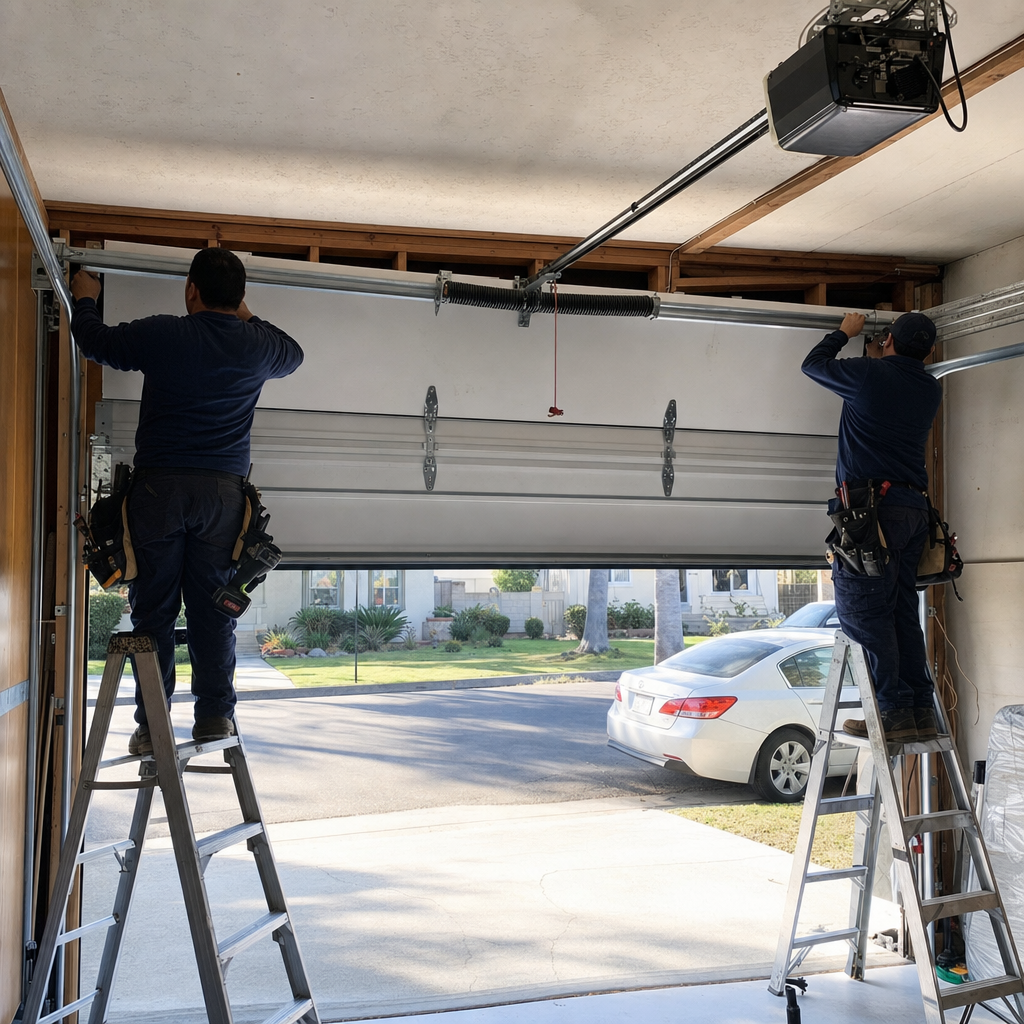
Some components need a professional’s hands and eyes once a year. This isn’t an upsell — it’s a practical reality. Torsion springs operate under several hundred pounds of tension, and cables run on a geometry that’s only visible from specific angles with the right lighting. In 18 years of garage door work in Los Angeles, the most common emergency calls we receive are from homeowners who skipped annual professional inspections for three or four years in a row.
- Professional spring inspection and tension check. Springs have a rated cycle life — typically 10,000 cycles for standard springs, 20,000 to 30,000 for high-cycle versions. In a Los Angeles household where the door opens and closes four to six times daily, a 10,000-cycle spring lasts roughly four to five years. Annual inspection catches metal fatigue before the spring snaps mid-cycle.
- Cable condition assessment. The fraying patterns we see on cables in uncovered Valley driveways — Reseda, Canoga Park, Northridge — are consistently more advanced than cables in shaded installations, because UV exposure degrades the cable jacket and accelerates individual wire strand oxidation. A professional can spot fraying at the drum end that’s invisible to a homeowner standing at floor level.
- Opener force and travel limit calibration. Opener sensitivity drifts over time. Most LiftMaster, Genie, and Chamberlain openers have adjustment screws for open and close force — if the door strains to complete a cycle, the motor is working harder than it should, shortening its lifespan. This calibration takes about 10 minutes by someone who knows the unit.
- Panel and frame alignment check. Los Angeles sits in an active seismic zone. Even minor earthquakes — the kind that barely wake anyone up — can shift a door frame slightly out of square. A door that’s been running slightly racked for a year will show asymmetric wear on rollers, cables, and springs. Catching it early is a five-minute alignment tweak; catching it late is a panel replacement.
Which Lubricants to Use in Los Angeles — Coastal vs. Inland
This is the section most generic checklists get wrong, and it’s the mistake we see causing the most accelerated wear in Los Angeles homes. Lubricant selection isn’t universal — it depends on where in the region your home is and what environmental stresses dominate your zip code.
What to Use and Where
- White lithium grease (aerosol): The right choice for torsion spring coils, hinge pivots, and roller stems across most of Los Angeles. It stays in place, doesn’t attract excessive grit, and handles the temperature range from coastal mornings to inland afternoons. Brands like CRC White Lithium or 3-IN-ONE Professional are reliable and widely available.
- Silicone spray: Best for the bottom rubber seal and the weather stripping around the door frame — particularly in coastal neighborhoods like Santa Monica, Playa del Rey, and Manhattan Beach, where the marine layer makes rubber degrade faster. Silicone keeps the rubber pliable without attacking the material the way petroleum-based products do.
- Dedicated garage door lubricant (like LiftMaster’s 50): Formulated specifically for torsion springs and is worth using if you have a premium Clopay or Amarr door where you want the cleanest result. It’s thinner than lithium grease and penetrates spring coils more completely.
What to Avoid
- WD-40 on springs or hinges: WD-40 is a water-displacing solvent — it removes existing lubrication rather than providing it. In coastal LA zip codes, spraying WD-40 on torsion springs strips the thin protective coating on the metal, then leaves the surface temporarily wet. Marine-layer moisture binds to that wet surface, and rust follows within weeks. We see this pattern regularly in homes in Venice, Culver City, and the beach cities.
- Grease on the tracks: Tracks need to stay clean and slightly rough so rollers maintain contact. Lubricating the track channel causes rollers to slip, and during the acceleration phase of a closing door, that slip translates into banding — the door skipping sideways in the track, which eventually pulls a roller out entirely.
- Heavy automotive grease on nylon rollers: Nylon rollers don’t need lubrication on the wheel surface — only on the steel stem that sits in the bracket. Packing the wheel with grease traps the fine particulate that’s endemic to LA air quality and turns it into an abrasive paste.
How to Spot Early Cable Fraying Before It Becomes a Crisis
Garage door cables carry most of the door’s weight every time it moves. They’re also one of the most visually inspectable components, if you know where to look and what you’re seeing. In Los Angeles specifically, UV exposure on uncovered driveways — especially in the eastern San Fernando Valley — accelerates the oxidation of individual wire strands in a way that’s predictable and detectable before failure.
Where to Look
- At the bottom cable bracket. Crouch down and look at the point where the cable loops through the bottom corner bracket on each side of the door. This is where we find fraying first, roughly 80% of the time, because the cable bends sharply around the bracket under full load. Even two or three broken individual strands here are a warning sign that warrants replacement soon.
- At the drum. The drum is the spool at the end of the torsion bar above the door. Cables wrap around it as the door opens. UV-degraded cables often show fraying where they first contact the drum edge. You’ll need a flashlight and to stand on a ladder — this is not visible from the floor.
- Along the cable run. Run your eye down the cable from top to bottom while the door is closed. You’re looking for kinks, rust-colored discoloration (oxidation), or visible separation of individual strands. In homes where sprinklers hit the garage face, rust progresses faster than usual along the full cable length.
One firm rule: if you see frayed or broken strands, don’t keep operating the door. A cable under load doesn’t fray to failure slowly — it fails suddenly, and a snapped cable under tension can cause serious injury or allow the door to fall. This is a same-day repair call, not a weekend project.
How to Test Auto-Reverse Sensitivity — and Why It Matters More in LA
Federal law has required auto-reverse functionality on all garage door openers sold in the United States since 1993. But having the feature and having it calibrated correctly are two different things. In Los Angeles, where the combination of frequent deliveries, dense foot traffic, and families with young children means garage doors interact with people at unusually high rates, a de-sensitized auto-reverse is a genuine safety gap.
The Cardboard Box Test (Do This Now)
- Place a flat cardboard box — about two inches thick — flat on the ground in the center of the door opening.
- Close the door using the wall button or remote.
- When the door strikes the cardboard, it must immediately reverse direction. “Immediately” means within one to two seconds of contact — not after the motor strains against the resistance for several seconds.
- If the door pushes through or crushes the box before reversing, the close-force sensitivity is set too high. On most LiftMaster and Chamberlain models, there’s a labeled adjustment dial on the motor head for “Close Force” — turn it toward the lower setting in small increments and retest.
- If the door reverses before touching the box, the sensitivity is too low — the door may reverse on cold mornings when the seals are stiffer, interpreting that resistance as an obstruction. Adjust the close-force dial upward slightly and retest.
The Photo-Eye Test
- With the door open, press the button to close it.
- While the door is in motion, pass a broom handle through the photo-eye beam at about mid-height. Do not put your hand in the path.
- The door must stop and reverse within one second. If it doesn’t, clean both sensor lenses, check for misalignment (the indicator lights should be solid, not blinking), and retest. If the problem persists after cleaning and alignment, the sensor wiring or the logic board needs professional attention.
Test both the mechanical auto-reverse and the photo-eye sensors every six months. Log the results with a date — if a future technician asks when you last tested it, you’ll have the answer.
The Most Skipped Maintenance Task: Bottom Seal Replacement
If we had to name the single most under-maintained component on residential garage doors in Los Angeles, it’s the bottom weather seal — the flexible rubber strip that runs the full width of the door’s base. Homeowners almost never notice it until the damage it was supposed to prevent has already happened.
What a Failing Bottom Seal Causes
- Concrete staining. When the seal gaps, rain and runoff — including the oily surface water common on LA residential streets — wicks under the door and saturates the concrete slab. The staining is often permanent without professional cleaning.
- Pest entry. A gap of even a quarter inch is enough for rats, mice, and cockroaches. In neighborhoods like Highland Park, Echo Park, and Koreatown where urban wildlife pressure is higher, a deteriorated bottom seal is frequently the entry point for rodent infestations that later spread into living spaces.
- Motor strain. A cracked or collapsed seal creates friction drag at the bottom of each open cycle. Over hundreds of cycles, this added resistance shortens the motor lifespan — we’ve opened Wayne Dalton and Raynor openers where the motor showed premature brush wear directly traceable to a dragging bottom seal.
- Fine dust infiltration. During Santa Ana events, wind-driven dust infiltrates any seal gap and deposits inside the garage. For homeowners using their garage as a workshop or storing finished goods, this is a direct quality-of-life issue.
When to Replace It
Inspect the bottom seal every six months as part of your biannual checklist. Replace it when you see cracking along the surface, compression set (the seal no longer springs back to its original profile after compression), visible gaps at the corners, or any point where you can see daylight under the closed door from inside. Replacement seals are inexpensive — typically $20 to $60 in materials — and the labor is one of the simpler tasks on a door. There’s no justification for deferring it.
Common Mistakes to Avoid
- Using WD-40 as a garage door lubricant. As covered above, WD-40 strips lubrication from metal and leaves surfaces vulnerable to rust — especially damaging in coastal Los Angeles zip codes where marine-layer humidity is constant. Use white lithium grease on metal components instead.
- Lubricating the tracks. The tracks are meant to stay clean and dry so the rollers grip correctly. Greasing the tracks creates a surface that collects dust and debris, eventually impeding roller movement rather than helping it.
- Ignoring a door that’s “a little slow.” A door that takes noticeably longer to open than it did six months ago is telling you something. In our experience, a sluggish door is usually a spring losing tension, a roller failing, or the opener working against misaligned tracks. Caught early, it’s a one-visit fix. Left alone, one of those components will fail completely.
- Over-tightening the limit adjustment screws on the opener. Homeowners sometimes compensate for a door that doesn’t fully close by winding the close-force adjustment to maximum. This forces the motor to work against whatever is actually causing the problem — binding rollers, a bent track, a misaligned door — rather than fixing it. Excessive close-force settings can trip the thermal overload on a Genie or Craftsman opener and shorten motor life significantly.
- Skipping the balance test after spring replacement. If a spring was recently replaced by any technician (including a previous company), test the manual balance within the first month. Springs are sometimes tensioned slightly off from factory spec, and a door that’s slightly heavy on one side will cause asymmetric cable wear that shows up six months later.
- Painting over the bottom seal or weather stripping. We see this occasionally in older Los Angeles homes where garage doors were painted without masking. Paint makes rubber seals rigid and unable to conform to the concrete surface — defeating the entire function of the seal within one season.
- Assuming a remote problem is always the battery. A remote that stops working intermittently — or works only from close range — usually has a battery issue. But a remote that stops working completely, especially if the wall button still works, often means the receiver antenna on the opener has separated or the logic board has developed a fault. Replacing the battery and declaring it fixed misses the underlying issue.
When to Call a Professional
Some maintenance tasks are genuinely safe for a careful homeowner. Others aren’t — not because of skill, but because of the physics involved. Call a professional immediately when you see any of the following:
- A torsion spring that is visibly broken, separated, or has a gap in the coil.
- Any frayed or broken strands on the lift cables.
- The door falling faster than normal when released in manual mode — this is a spring tension failure.
- A bottom section that has caved in or panels that have buckled, which often means the door struck an obstruction and the internal structure has shifted.
- An opener that runs but the door doesn’t move — the disconnect clip, the trolley, or the drive mechanism has failed.
- Any situation where the door won’t fully close and you can’t identify a clear, simple cause.
Springs and cables are under significant mechanical tension — these are not components to adjust without proper training and tools. Garage Door Repair in Los Angeles with Noble Garage Door Repair means Daniel Martin is the one who shows up — not a subcontractor dispatch. For any of these situations in Los Angeles, call (424) 344-4986. Free estimates, no obligation.
Frequently Asked Questions
How often should I lubricate my garage door in Los Angeles?
Twice a year is the right interval for most Los Angeles homes — once in early spring after the rainy season and once in early fall before Santa Ana wind season. Coastal homes in areas like Santa Monica, Marina del Rey, or Hermosa Beach may benefit from a third pass in mid-summer, because the marine layer creates persistent humidity that accelerates oxidation on unprotected metal hardware. Use white lithium grease on springs and hinges, and silicone spray on rubber components. Call (424) 344-4986 if you’d like Daniel to assess your door’s current condition before setting your maintenance schedule.
Can I replace my own garage door springs in Los Angeles?
We don’t recommend it. Torsion springs are wound under several hundred pounds of torque, and releasing or re-tensioning them without the right winding bars, safety cables, and experience creates a genuine injury risk. California has no specific code prohibiting homeowner spring replacement, but the liability and physical danger are real. This is one of the clearest cases where the cost of a professional repair — typically $180 to $320 for a single torsion spring in the Los Angeles market — is straightforwardly worth it compared to the risk of a DIY attempt going wrong.
What’s the best garage door lubricant for homes near the LA coast?
White lithium grease in aerosol form is the right choice for metal-to-metal contact points — springs, hinges, roller stems, and bearing plates — in all Los Angeles locations including coastal areas. For rubber components like the bottom seal and frame weather stripping, use a silicone-based spray, which keeps rubber pliable without degrading it. Avoid WD-40 entirely on any metal hardware near the coast — it removes protective coatings and leaves metal surfaces exposed to salt-air oxidation.
How do I know if my garage door is out of balance?
Disconnect the opener by pulling the red emergency release cord while the door is fully closed. Lift the door by hand to waist height — roughly three to four feet off the ground — and let go. A balanced door stays at that height without drifting up or dropping. If it falls toward the floor, the springs are under-tensioned; if it rises toward the open position, they’re over-tensioned. Either way, operating the door with a misaligned spring balance accelerates wear on cables, rollers, and the opener motor. Have a technician adjust the tension before running it on the opener again.
How long do garage door springs last in Los Angeles?
Standard torsion springs are rated for approximately 10,000 open-close cycles. In a typical Los Angeles household using the garage door four to six times daily, that translates to roughly four to six years of service life. Higher-cycle springs rated at 20,000 or 30,000 cycles are available and cost more upfront, but last twice to three times as long — a worthwhile upgrade if you’re already replacing a spring. Salt-air exposure in coastal areas can shorten even a standard spring’s life by one to two years if the spring isn’t lubricated on the biannual schedule above.
What causes garage door openers to fail prematurely in LA homes?
The three most common causes we see in Los Angeles are: (1) running the opener against a door with spring or hardware problems, which forces the motor to work at elevated current draw over hundreds of cycles; (2) heat exposure in garages without ventilation, which is significant in the Valley where enclosed garage temperatures can exceed 120°F in summer, degrading both the logic board and the drive system; and (3) fine particulate infiltration through gaps in the door seals, which settles into the motor assembly. Brands like LiftMaster and Chamberlain build openers to handle these conditions better than average, but no opener survives long-term neglect of the door mechanics it’s lifting. For opener issues across the full range of brands we service, visit our Garage Door Opener in Los Angeles page.
The Bottom Line
A well-maintained garage door in Los Angeles lasts decades. The ones that fail early almost always share a common history: the wrong lubricant used in the wrong way, the bottom seal left cracked for one season too many, the balance test never performed after a spring swap, the auto-reverse sensitivity never checked after the original installation. None of these are difficult tasks. What they require is a checklist calibrated to this city’s actual climate — marine layer, Santa Ana winds, UV intensity, wildfire smoke — rather than a generic set of instructions written for a national audience. Follow the schedule in this guide, use the right products for your specific neighborhood’s conditions, and your door will give you years of reliable service. If anything looks off, Daniel Martin and the team at Noble Garage Door Repair Los Angeles are available for free estimates — and if you’re considering replacing an aging door entirely, the Garage Door Installation in Los Angeles page walks through your options in the same level of detail. Call (424) 344-4986 anytime you have a question — no pressure, no dispatch runaround, just a straight answer from someone who has been doing this work in Los Angeles since 2008.
Ready for a Professional Eyes-On Inspection?
If you’ve gone through this checklist and found something that warrants a closer look — frayed cables, a door that won’t balance, a spring that’s past its cycle count, or an opener that’s working harder than it should — call Noble Garage Door Repair Los Angeles at (424) 344-4986. Daniel Martin personally handles every inspection and repair. With 555 verified reviews averaging 4.9 stars, you’ll have a clear picture of what to expect before he arrives. Estimates are free, and emergency service is available when a failing door can’t wait until Monday.
Written by Daniel Martin, Owner & Lead Technician at Noble Garage Door Repair Los Angeles, serving Los Angeles since 2008.