
Last updated June 28, 2026
Seasonal Garage Door Care for Los Angeles: Year-Round Homeowner’s Guide
The busiest repair month in my Los Angeles schedule isn’t January or February — it’s October, right after Santa Ana wind season, when doors that were stressed by months of heat and debris impact finally give out. That pattern isn’t random. It’s the direct result of four distinct environmental phases that Southern California homeowners rarely think about, because none of them involve snow or ice. This guide throws out the generic Midwest-written seasonal care calendar and rebuilds it entirely around what actually happens to garage door hardware in Los Angeles — the marine layer, the UV peak, wildfire smoke, and those Santa Ana winds.
Quick Answer
Caring for your garage door in Los Angeles means scheduling maintenance around four real local stressors — not the four calendar seasons. The marine layer from December through May drives coastal corrosion, July and August UV peaks degrade seals and paint, late-summer wildfire smoke clogs motor units, and October Santa Ana winds are the single biggest emergency call trigger we see all year. A twice-yearly inspection — once in late spring (May) and once in early fall (September) — aligned to these actual environmental events will prevent most of the repair calls we respond to across Los Angeles.
Table of Contents
- Why Los Angeles Has Four Real Garage Door Seasons
- The Marine Layer Problem: Coastal Corrosion from December Through May
- Spring Winds and Summer UV: What Happens to Your Door from April Through August
- Wildfire Smoke and Your Opener: A Cleaning Protocol Most Homeowners Skip
- Santa Ana Season: The Spring Tension Check That Prevents Emergency Calls
- Month-by-Month Los Angeles Garage Door Maintenance Calendar
- The Mild Winter Trap: Why LA Homeowners Defer Maintenance They Shouldn’t
- Common Mistakes to Avoid
- When to Call a Professional
- Frequently Asked Questions
- The Bottom Line
Why Los Angeles Has Four Real Garage Door Seasons
Most seasonal garage door guides are written for climates with hard winters. They focus on freeze-thaw cycles, ice buildup on tracks, and lubricants that thicken in sub-zero temperatures. None of that applies in Los Angeles, which is exactly why so many local homeowners skip seasonal maintenance entirely — the advice they find online doesn’t feel relevant, so they assume their doors don’t need it.
They do. The stressors are just different here, and in some ways more insidious because they work slowly and invisibly until something breaks.
The four environmental phases that actually matter for Los Angeles garage doors are:
- Marine Layer Season (December–May): Persistent coastal humidity from ocean air that doesn’t burn off until late morning. This is the primary corrosion driver for homes within five miles of the coast — from Malibu and Santa Monica through Venice, Playa del Rey, and El Segundo.
- Spring Wind Season (March–May): The Diablo and seasonal offshore winds that carry fine debris, sand, and particulates into tracks, rollers, and bearing plates.
- UV and Heat Peak (June–September): Intense solar radiation that degrades rubber bottom seals, cracks painted steel panels, and dries out lubricant in torsion springs faster than any other season.
- Santa Ana and Wildfire Season (October–November): High-speed offshore winds that mechanically stress springs and panels, combined with smoke particulates that infiltrate opener motor units.
Once you see the year in these four phases, the maintenance calendar practically writes itself.
The Marine Layer Problem: Coastal Corrosion from December Through May
If you live west of the 405 — in Brentwood, Culver City, Mar Vista, Manhattan Beach, or anywhere closer to the water — your garage door hardware is sitting in a salt-air environment for a significant part of every year. The marine layer isn’t just fog. It’s moisture-laden air with elevated sodium chloride content that settles on every exposed metal surface: torsion spring coils, hinge knuckles, roller stems, track seams, and cable drum hardware.
Steel garage door hardware isn’t designed to resist this kind of persistent low-level corrosion indefinitely. What we see in practice — after 18 years of working Los Angeles doors — is that springs on homes within three miles of the coast show visible surface oxidation within two to three years without regular attention, and can fail four to six years earlier than the same hardware on a door in Pasadena or the San Fernando Valley.
The good news is that the fix is straightforward and cheap. Here’s what to do at the hardware level:
- Apply a lithium-based or silicone lubricant to torsion spring coils in December, before the heaviest marine layer months. Don’t use WD-40 — it’s a solvent that strips existing lubrication rather than adding it.
- Wipe down hinge plates, roller stems, and cable drum hardware with a dry cloth first to remove any surface moisture or fine debris, then apply lubricant to moving joints only — not the tracks themselves.
- Inspect the bottom corners and weatherstripping seams where water pools after rain. Trapped moisture under weatherstripping accelerates rust on the door’s lower rail faster than anywhere else on the frame.
- Check for rust bloom on spring coils every February. Surface rust at this stage is treatable with a light wire brush and fresh lubricant. Deep pitting means the spring’s structural integrity is already compromised and replacement is the right call.
Homeowners who add this single December hardware check to their routine see dramatically longer hardware life. It takes about 20 minutes and costs nothing beyond a can of spray lubricant.
Spring Winds and Summer UV: What Happens to Your Door from April Through August
April and May bring drier air to Los Angeles, but they also bring persistent winds — both afternoon thermal breezes from the Inland Empire and occasional offshore events that carry fine sand and debris from the desert. Those particulates find their way into the track channel and roller bearings, where they act as an abrasive compound every time the door cycles. If you’ve noticed your door getting noisier in spring, that’s usually the cause.
A quick track cleaning in April pays dividends all summer. Use a damp cloth to wipe the inside channel of both vertical and horizontal tracks, removing accumulated grit before re-lubricating rollers. Don’t apply lubricant directly to the track surface — it collects more debris and compounds the problem.
From June through August, UV exposure is your primary concern. Southern California’s sun intensity is classified as extreme during peak summer, and it does three specific things to garage doors:
- Degrades rubber bottom seals: The bottom seal (astragal) takes direct sunlight on the south and west-facing doors that are most common in Los Angeles neighborhoods. After two to three seasons of peak UV exposure, the rubber becomes brittle and cracks, allowing insects, dust, and water to enter under the door.
- Fades and oxidizes painted steel panels: Clopay, Amarr, and Wayne Dalton steel doors with factory-finish paint show measurable oxidation after five or six Los Angeles summers without UV-protective treatment. Repainting or applying a UV-protective clear coat before summer extends panel life significantly.
- Thins lubricant in torsion springs: Heat causes lubricant to thin and migrate away from the spring coils, leaving them dry by mid-summer. A light reapplication in July — after the heat has already settled in — is a small task that prevents dry-spring failures in August and September, which is the second-busiest repair window we see.
Wildfire Smoke and Your Opener: A Cleaning Protocol Most Homeowners Skip
This is the section that surprises most Los Angeles homeowners, because it isn’t covered in any generic maintenance guide. During active wildfire events — which have become regular late-summer and fall occurrences across the hills above Burbank, Chatsworth, Sylmar, and the canyons above Malibu — smoke particulates are fine enough to enter through the ventilation gaps on any residential garage door opener unit.
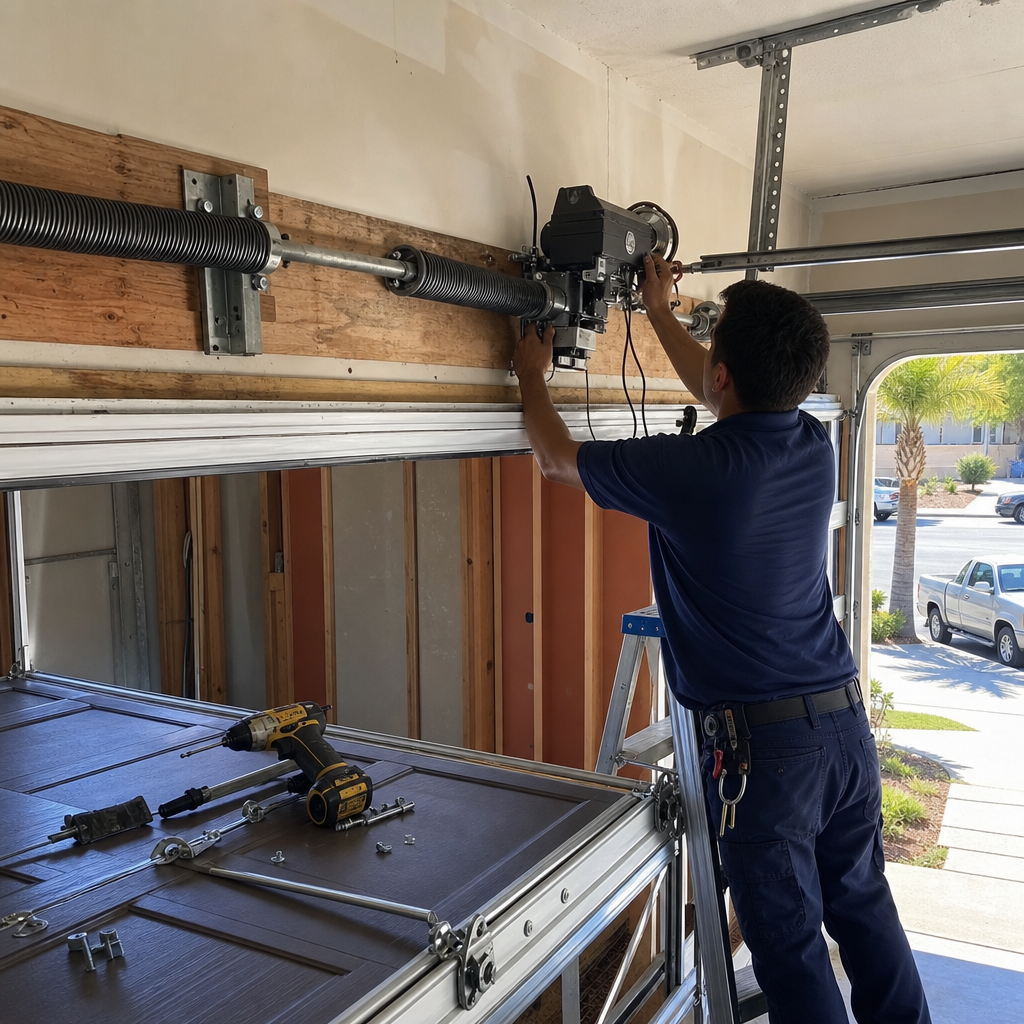
Those particulates don’t just pass through. They settle on the logic board, the drive gear assembly, and the motor windings inside units like the LiftMaster 8500W, Chamberlain B6765, and comparable Genie and Craftsman models. Over multiple fire seasons without cleaning, the buildup creates two problems: insulation on circuit board traces that causes intermittent signal failures, and abrasion on plastic drive gears that accelerates wear.
Here’s the cleaning protocol that most homeowners don’t know exists:
- After any significant smoke event, allow the air to clear for 24–48 hours before opening the opener housing. Opening it while smoke is still heavy draws more particulates inside.
- Disconnect power to the opener at the outlet before removing the housing cover. Never work inside a powered unit.
- Use a clean, soft-bristle paintbrush to gently brush particulate accumulation from the logic board surface and visible gear housing. Don’t use compressed air — it drives particulates deeper into the motor windings.
- Use a can of electronics-safe compressed air only on the logic board’s connector ports and track channels, held at least 12 inches from the surface.
- Inspect the drive gear through the housing opening for grit accumulation around the worm drive. If you see heavy deposits, this is a job for a technician — disturbing gear mesh without proper realignment can create new problems.
- Restore power and run three test cycles, listening for any new grinding or hesitation that wasn’t present before the fire event.
In areas like Topanga Canyon, La Cañada Flintridge, and the hills above Altadena, we see this issue every fall. The homeowners who catch it early keep their openers running. Those who don’t often replace a unit that could have been cleaned for nothing.
Santa Ana Season: The Spring Tension Check That Prevents Emergency Calls
October is the month that generates the most emergency repair calls on our Los Angeles schedule, and Santa Ana winds are the consistent trigger. Here’s the mechanical reason: a standard two-car garage door weighs between 150 and 250 pounds. Torsion springs counterbalance that weight so the opener only has to move a fraction of the door’s actual mass. When Santa Ana winds hit — gusting to 50 or even 70 mph in the passes above Granada Hills, Chatsworth, and Thousand Oaks — they create lateral force on the door panels that the spring system wasn’t designed to absorb. If those springs were already at the low end of their tension tolerance going into October, a high-wind event is often enough to push them to failure.
The preventive action is simple: have a spring tension check performed in September, before the first Santa Ana event of the season. This doesn’t mean replacing springs that are fine — it means verifying that they’re balanced and within specification so a wind event doesn’t become an emergency call at 10 p.m.
Signs that your springs should be evaluated before fall:
- The door moves slower going up than it did six months ago
- The door doesn’t stay in place when manually stopped halfway — it either falls or rises on its own
- You can see visible gaps or uneven spacing in the torsion spring coils
- The opener strains audibly on the way up, especially in the first 18 inches of travel
- One side of the door appears to hang lower than the other when closed
Any of these signs in August or September means the spring system needs professional evaluation before the winds arrive. A spring that fails during a Santa Ana event — especially on a door facing west or north — can damage panels, bend tracks, and in rare cases injure anyone nearby. The tension check costs a fraction of an emergency repair call. For homeowners whose Garage Door Repair in Los Angeles needs run deeper, we can assess the full system in a single visit.
Month-by-Month Los Angeles Garage Door Maintenance Calendar
This calendar is built specifically around Southern California’s real environmental events — not the four-season model that doesn’t apply here.
- January: Inspect weatherstripping after any winter rain events. Los Angeles’s episodic storms can drive water under door seals that cracked in the prior UV season. Check that the door threshold seal creates full contact across the entire bottom edge.
- February: Marine layer peak. Inspect torsion spring coils for surface rust. Check hinge knuckles and cable drum hardware for oxidation. Apply lithium or silicone lubricant to spring coils and all roller stems. For coastal ZIP codes (90291, 90266, 90254), do this without fail.
- March: Wind season begins. Wipe down track interiors to remove any winter debris accumulation. Test door balance manually: disconnect the opener, lift the door to waist height, and release — it should stay in place.
- April: Spring cleaning. Clean track channels of fine sand and particulates. Lubricate all hinges, rollers, and bearing plates. Inspect the bottom seal for UV cracking that may have gone unnoticed over winter. Replace if cracked or stiff.
- May: Full visual inspection of panels for paint oxidation or surface damage before peak UV season. This is the best time to repaint or touch up steel panels before summer heat sets in. Check opener remote battery and wall button response.
- June: “June Gloom” brings unusual coastal humidity. Despite the overcast, UV levels remain high when sun breaks through. Reapply lubricant to spring coils if the door has been cycling heavily in spring. Check that the opener’s safety auto-reverse function is working — place a 2×4 flat on the ground under the door and let it close; it must reverse on contact.
- July: UV peak. Reapply torsion spring lubricant — summer heat thins and migrates prior applications. Inspect rubber bottom seal for new cracking. Keep the opener unit’s ventilation slots clear of cobwebs and dust, which are common in garage spaces during dry summer months.
- August: Wildfire smoke watch. After any air quality alert, follow the opener cleaning protocol outlined in the section above. This is also the time to schedule a professional inspection if the door has gone 12 months without one — catching worn parts before fall is far less expensive than emergency service.
- September: Critical month. Have a spring tension check performed before the first Santa Ana event. Inspect all hardware fasteners — vibration from summer use can back out lag bolts on track brackets. A loose track bracket is a fall emergency waiting to happen.
- October: Santa Ana season in full effect. Avoid operating the door manually or with the opener during extreme wind events if possible. After any major wind event, visually inspect panels for dings or bends, check cables for fraying at the drum, and verify the door opens and closes evenly on both sides.
- November: Post-Santa Ana inspection. Replace any hardware that shows stress from the wind season. This is a natural transition point to schedule any deferred repairs before the marine layer season returns in December.
- December: Pre-marine-layer preparation. Lubricate all metal-to-metal contact points. Apply a corrosion-inhibiting lubricant to spring coils for homes within five miles of the coast. Check that the door’s bottom seal is intact heading into the rain season.
The Mild Winter Trap: Why LA Homeowners Defer Maintenance They Shouldn’t
There’s a pattern we see regularly across Los Angeles: homeowners who moved here from colder climates brought their garage door maintenance habits with them — which means servicing the door in spring after winter. That timing made sense in Chicago or Denver, where winter puts visible stress on hardware. Here, it results in doors going 14 to 18 months between meaningful attention, because “spring service after winter” in Los Angeles doesn’t feel urgent when winter was 60 degrees and sunny.
The mild climate creates a false sense that nothing is degrading. In reality, the marine layer has been working on spring coils since November, the UV season has been cracking the bottom seal since June, and the opener has accumulated a season’s worth of wildfire smoke without being opened and cleaned. None of these processes announce themselves loudly until something fails.
In a freeze-thaw climate, a deteriorating bottom seal lets in visible ice and cold air — the homeowner notices and acts. In Los Angeles, a deteriorated seal lets in fine dust, small insects, and the occasional moisture event, none of which create immediate urgency. The seal gets ignored until it’s so compromised that the door threshold is effectively open to the garage floor.
The solution isn’t to pretend Los Angeles has winters — it’s to replace the winter trigger with the two local triggers that actually matter: the start of marine layer season in December, and the pre-Santa Ana inspection window in September. Build those two dates into your calendar and the LA-specific degradation cycle stops getting ahead of you.
If you’re considering upgrading to a new door that’s better suited to coastal conditions — aluminum-core or fiberglass construction handles marine layer environments significantly better than untreated steel — our Garage Door Installation in Los Angeles page covers the material options in detail.
Common Mistakes to Avoid
- Using WD-40 on torsion springs and tracks. WD-40 is a water displacer and solvent, not a lubricant. It strips existing grease from spring coils and track hardware, leaving metal surfaces drier and more corrosion-prone than before. Use white lithium grease or a dedicated garage door silicone lubricant instead.
- Ignoring the door balance test. Most Los Angeles homeowners never disconnect their opener and manually check whether the door holds position at mid-travel. This 60-second test reveals spring tension problems before they become failures — skipping it means a worn spring usually announces itself by snapping instead of by gradual symptoms.
- Leaving the opener housing uncleaned after wildfire smoke events. This is the highest-frequency mistake we see in hillside neighborhoods above the Valley and the Westside canyons. A single deep smoke season can deposit enough particulate inside a LiftMaster or Chamberlain unit to shorten its life by three or more years.
- Applying lubricant to the inside of the track. The track is a guide, not a bearing surface — lubricant on the track interior collects grit and debris and creates an abrasive paste that accelerates roller wear. Lubrication belongs on the roller stems, hinge knuckles, and spring coils, not the track channel itself.
- Deferring the September spring tension check because the door “still works fine.” In Los Angeles, torsion springs that are at the end of their service life often operate without obvious symptoms right up until they snap — frequently during the mechanical stress of a Santa Ana wind event. “Fine” in September can mean “broken” by October 15th.
- Replacing only one spring when two-spring systems fail. On doors with dual torsion springs — which are standard on most two-car doors — replacing only the broken spring leaves the aging partner spring in place. The surviving spring typically fails within months, requiring a second service call. Both springs age at the same rate; replace them as a pair.
- Using the wrong opener for a coastal garage environment. Standard belt-drive openers with exposed metal components corrode faster in marine-layer-heavy ZIP codes like 90266 (Manhattan Beach) and 90291 (Venice). Openers with sealed, corrosion-resistant drive systems — available on several Genie and LiftMaster models — are a better specification for those addresses.
When to Call a Professional
Some garage door maintenance tasks are genuinely homeowner-friendly: wiping tracks, replacing batteries, lubricating hinges, swapping a cracked bottom seal. Others involve stored mechanical energy that can cause serious injury if handled incorrectly.
Call a professional when you’re dealing with any of the following:
- A broken or visibly cracked torsion or extension spring
- A door that won’t stay balanced at mid-travel when the opener is disconnected
- Frayed or kinked lift cables
- A bent track that prevents smooth door travel
- An opener that reverses immediately, won’t close fully, or produces grinding noises
- Any post-Santa Ana damage where panels are visibly bent or the door tracks out of alignment
Torsion springs in particular are under extreme tension — attempting to adjust or replace them without proper training and tools has caused serious injuries. Noble Garage Door Repair Los Angeles offers free estimates across Los Angeles — call (424) 344-4986 and Daniel will assess the situation directly, not route you through a call center.
Frequently Asked Questions
How often should I service my garage door in Los Angeles?
Twice a year is the right frequency for most Los Angeles homes — once in September before Santa Ana season and once in December before marine layer season peaks. Homes within three miles of the coast, or in hillside areas with frequent wildfire smoke exposure, benefit from a lighter mid-year check in April as well. If your door has gone more than 14 months without any maintenance, schedule a full inspection now rather than waiting for the calendar trigger.
Does the marine layer actually cause garage door damage in Los Angeles?
Yes, and it’s the most underappreciated source of garage door hardware degradation in coastal Los Angeles neighborhoods. The marine layer deposits salt-laden moisture on exposed steel hardware — torsion spring coils, cable drums, hinge plates — during the overnight and early-morning hours from roughly December through May. Without regular lubrication and inspection, this leads to surface oxidation that weakens spring coils and corrodes hinge hardware years ahead of normal service life. Homes in Venice, Santa Monica, Playa del Rey, Manhattan Beach, and similar coastal neighborhoods should treat this as their highest-priority maintenance item.
Can wildfire smoke really damage my garage door opener?
It can, and it does — particularly for homeowners in hillside neighborhoods near the Angeles National Forest, Topanga State Park, and the canyons above the San Fernando Valley. Smoke particulates are fine enough to enter opener housings through standard ventilation gaps, and they accumulate on logic boards and drive gear assemblies over multiple fire seasons. The symptoms show up as intermittent signal failure, unexpected reversals, or accelerated gear wear. The cleaning protocol in this guide addresses it, but if the opener has been through several heavy smoke seasons without cleaning, a professional inspection is worth scheduling before the next fire season. Call (424) 344-4986 for a free assessment.
When should I replace my garage door springs in Los Angeles?
Most torsion springs are rated for 10,000 cycles — roughly seven to ten years of normal residential use. In coastal Los Angeles, corrosion from marine layer exposure can reduce that effective lifespan to five or six years without regular maintenance. The clearest indicator isn’t a number — it’s the balance test: disconnect your opener, lift the door to waist height, and release it. If it falls or rises instead of holding position, the spring tension is outside specification and replacement is the right call, ideally before fall Santa Ana season stresses the system further.
What’s the best lubricant for garage door springs in Southern California’s climate?
White lithium grease or a dedicated silicone-based garage door lubricant outperforms general-purpose sprays in Southern California’s climate. For coastal addresses with marine layer exposure, lithium grease provides a thicker moisture barrier on spring coils. For inland Valley areas with extreme summer heat, silicone spray stays fluid at higher temperatures and doesn’t thin and migrate as quickly. Either way, avoid petroleum-based products like WD-40 — they displace moisture temporarily but leave surfaces unprotected once they evaporate, and they attract debris.
My garage door opener is making new noises after last fall’s fires — what should I check first?
Start by checking the drive gear. On chain-drive and belt-drive openers — including common Craftsman, Chamberlain, and Genie models — smoke particulate accumulation on the worm gear and main drive gear creates a grinding or intermittent clicking sound that worsens as the deposit builds up. If you’re comfortable removing the housing cover with power disconnected, look for gray or brown grit accumulation around the gear housing. If the deposit is light, the cleaning protocol in this guide may resolve it. If the gear teeth show visible wear or chipping, the gear set needs replacement — that’s a 45-minute job for a technician. Call (424) 344-4986 for a free diagnosis.
The Bottom Line
Los Angeles garage doors don’t face ice or snow, but they face four real environmental threats that most maintenance guides don’t address: marine layer corrosion from December through May, UV degradation during peak summer, wildfire smoke infiltration in late summer and fall, and the mechanical stress of Santa Ana wind season in October. Two focused annual inspections — one in September before the winds, one in December before the marine layer peaks — will prevent the majority of the emergency repair calls we respond to across Los Angeles each year. Skip the generic seasonal advice, follow a calendar built around what actually happens here, and your door will outlast its rated service life. If something doesn’t look right, a second opinion costs nothing — call (424) 344-4986 for a free estimate from Daniel directly.
For opener-specific questions or if you’re considering a smart opener upgrade that handles Los Angeles’s connectivity and environmental demands, our Garage Door Opener in Los Angeles page covers what we’ve seen work well here.
Ready to Get Your Garage Door Inspected?
If anything in this guide sounds familiar — springs you haven’t checked in years, an opener that’s been through multiple fire seasons without cleaning, or a bottom seal that’s seen better days — the next step is a professional inspection before the next season’s stressors arrive. Daniel Martin personally handles every inspection and repair at Noble Garage Door Repair Los Angeles, which means you’ll get a straight answer from the person doing the work, not a sales pitch from someone who won’t be on the job. Call (424) 344-4986 to schedule your free estimate — we serve all Los Angeles neighborhoods from the Westside to the Valley to the South Bay, and emergency service is available when the door simply can’t wait.
Written by Daniel Martin, Owner & Lead Technician at Noble Garage Door Repair Los Angeles, serving Los Angeles since 2008. With 555 verified customer reviews averaging 4.9 stars, Daniel brings 18 years of specialized garage door experience to every inspection and repair.