
Last updated June 28, 2026
The Complete Guide to Garage Door in Los Angeles
Your garage door is the largest moving part of your home and, in most Los Angeles houses built after 1980, the primary entry point — yet the average homeowner can’t name the type of spring system their door uses, let alone when it was last serviced. That blind spot matters more here than in most cities. Coastal salt air, triple-digit Valley heat, hillside brush exposure, and seismic activity all quietly work against your door’s hardware in ways that aren’t obvious until something breaks at the worst possible moment. This guide connects those LA-specific realities to every practical decision you’ll make about your garage door — from reading your existing hardware to knowing what a fair repair quote looks like in this market.
Quick Answer
A garage door in Los Angeles is a mechanical system under constant environmental stress — from marine layer corrosion along the coast to thermal cycling in the San Fernando Valley — and it requires informed maintenance and occasional professional repair to stay reliable. Most LA homeowners will face at least one significant repair (springs, opener, or panel damage) every 7–10 years, with costs typically ranging from $150 for minor adjustments to $1,800+ for full door replacement depending on material and configuration. Understanding your specific door type, spring system, and local environmental exposure is the difference between a $200 fix and an avoidable $1,200 emergency call.
Table of Contents
- How LA’s Microclimates Affect Your Garage Door
- Torsion vs. Extension Springs: What LA’s Housing Stock Is Actually Running
- California Seismic Codes and Your Garage Door
- How to Read Your Door’s Hardware Before Calling Anyone
- Real Cost Tiers: Repair, Panel Replacement, and Full Replacement in LA
- Choosing the Right Door Material for Your LA Home
- Garage Door Openers: What Works Best in Los Angeles Homes
- A Practical Maintenance Schedule for LA Conditions
How LA’s Microclimates Affect Your Garage Door
Los Angeles isn’t one climate — it’s a dozen of them packed into 503 square miles, and each one degrades garage door hardware in a different way. What’s accelerating wear on a door in Santa Monica has almost nothing to do with what’s attacking a door in Chatsworth. Getting this right matters because the wrong door material or lubrication choice for your specific neighborhood shortens hardware life significantly.
The Coastal Zone: Santa Monica, Venice, Playa del Rey, El Segundo
Marine layer doesn’t just make mornings gray — it deposits fine salt particulate on every metal surface facing the ocean. We see torsion spring corrosion in these neighborhoods that would take 15 years to develop in Burbank happening in 6–8 years instead. Steel doors without a quality factory finish pit and rust faster here. Aluminum or fiberglass doors hold up better in the coastal zone, and spring hardware should be lubricated with a lithium-based product every six months rather than annually. If your coils show orange surface oxidation, that’s not cosmetic — it’s structural weakening.
The San Fernando Valley: Sherman Oaks, Woodland Hills, Van Nuys, Reseda
Heat is the primary enemy here. Summer temperatures regularly reach 105–112°F in the Valley, and an uninsulated garage can become a 130°F oven. That thermal cycling — extreme heat during the day, rapid cooling at night — causes metal tracks to expand and contract repeatedly, loosening hardware fasteners and warping wooden door panels over time. In the Valley, we consistently recommend R-value 18 or higher insulated doors, and we see more track misalignment calls from this area than anywhere else in Los Angeles. Wooden doors in Van Nuys and Reseda typically show stress cracking within 5–8 years without regular sealing.
Hillside and Brush Zone: Topanga, Laurel Canyon, Altadena, La Crescenta
Beyond summer heat, hillside homes face wildfire smoke infiltration that deposits fine carbon particulate inside opener motors and on nylon rollers. We’ve opened motor housings in Topanga and found them completely clogged with soot from seasonal fires. Homes in high fire hazard severity zones (HFHSZ) designated by CAL FIRE also face building code requirements around garage separation and ventilation that affect door selection. If you’re in a brush zone, keeping your opener motor covered during red flag events and cleaning rollers annually isn’t optional upkeep — it’s the difference between a functioning system and a prematurely failed one.
Torsion vs. Extension Springs: What LA’s Housing Stock Is Actually Running
Spring systems are the single most important — and most misunderstood — component of any garage door. They do the actual heavy lifting. A two-car steel door weighs 150–200 lbs, and without functioning springs, your opener motor would burn out within weeks trying to compensate. In Los Angeles specifically, the age of the housing stock creates a split that every homeowner should understand.
Extension Springs
Extension springs run along the horizontal tracks on each side of the door. They stretch and contract as the door moves. Homes built before 1993 — a significant chunk of the residential inventory in neighborhoods like Mid-City, West Adams, Highland Park, and large parts of the Valley — are disproportionately running original extension spring systems. These are older, less efficient, and more dangerous when they fail because a snapped extension spring can become a projectile. Current code requires safety cables threaded through extension springs to contain them if they break, but pre-1993 installations often lack these cables. If your home was built before 1993 and you’ve never had a spring inspection, assume the safety cables may be missing.
Torsion Springs
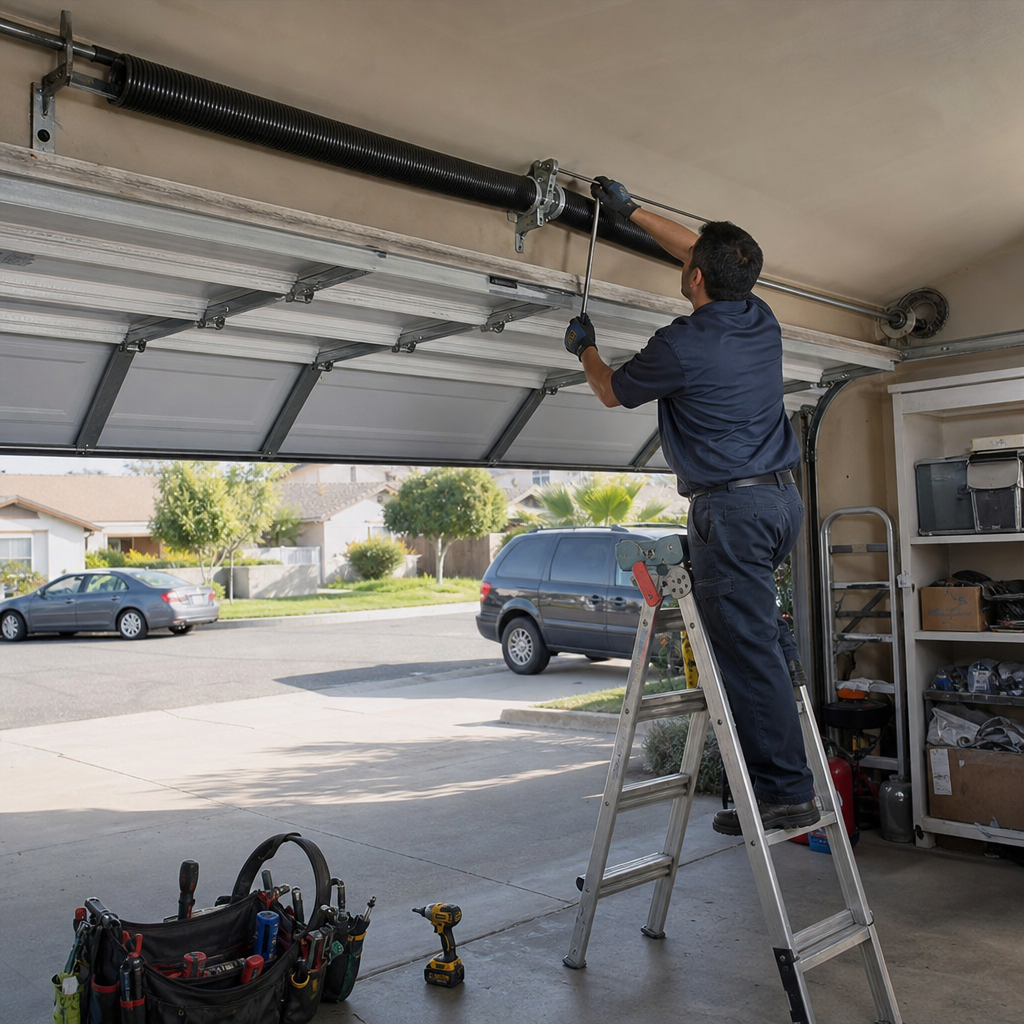
Torsion springs mount horizontally above the door opening on a steel shaft. They’re more durable, better balanced, and safer than extension systems — a broken torsion spring stays on its shaft rather than flying across the garage. Most doors installed after the mid-1990s use torsion systems. A standard torsion spring is rated for 10,000 cycles (one cycle = one open + one close). At the LA average of 4–5 cycles per day, that’s roughly 5–7 years of lifespan. Higher-cycle springs rated at 25,000–50,000 cycles are available and worth the upgrade cost on any door seeing heavy daily use.
Bottom line: If you don’t know which system your door uses, stand inside your garage and look above the door opening. One horizontal spring bar above the door = torsion system. Two springs running along the side tracks = extension system. Never attempt to adjust or replace either type yourself — spring tension is measured in hundreds of foot-pounds and causes serious injury when released unexpectedly.
California Seismic Codes and Your Garage Door
California’s seismic building standards directly affect garage door requirements in ways most homeowners never think about until they’re filing an insurance claim or selling their home.
Under California Building Code (CBC) Section 2308 and related Title 24 requirements, garage doors in new construction must meet specific bracing standards to remain functional after seismic events. The logic is practical: a door that jams shut after an earthquake can trap vehicles and block emergency access. FEMA’s post-Northridge earthquake research (the 1994 quake caused catastrophic garage door failures across the San Fernando Valley) directly influenced updated reinforcement standards that took effect in the late 1990s.
For existing homes, the relevant concern is door panel rigidity and track bracing:
- Horizontal bracing struts run across door panels to prevent racking during lateral movement. Many pre-1995 doors in Los Angeles lack adequate strut reinforcement.
- Track mounting brackets should be lag-bolted into structural framing, not just drywall. We find improperly anchored track hardware regularly in older Eastside and South Bay homes.
- Automatic reversing mechanisms on openers are required by California law (not just federal standards) — if your door doesn’t reverse when it contacts an obstacle, the opener is non-compliant and should be replaced.
If your home was built before 1993 and the garage door has never been retrofitted, it’s worth having the bracing hardware assessed — particularly if you’re in a liquefaction or high-shaking-intensity zone per the California Geological Survey maps covering parts of the Westside, San Fernando Valley, and South Los Angeles.
How to Read Your Door’s Hardware Before Calling Anyone
Before you call anyone, spend five minutes reading your existing hardware. You’ll get a clearer sense of what’s actually failing and you’ll be harder to upsell on parts you don’t need.
- Find the door’s data label. Most doors manufactured after 2000 have a sticker on the inside of the top panel or the door’s edge jamb. It lists the manufacturer (Clopay, Amarr, Wayne Dalton, etc.), model number, panel weight, and sometimes installation date. If it’s missing, the age of the hardware around it tells the story.
- Count the rollers. Standard rollers have 10 ball bearings and are rated for around 10,000 cycles. Higher-end nylon-coated rollers with sealed bearings last 2–3 times longer. If your rollers are bare steel with visible rust or wobble when you spin them by hand, they’re due for replacement.
- Check the torsion spring color code. Industry-standard torsion springs are color-coded on the end cones to indicate wire gauge and cycle rating. No color code = likely a non-standard or very old spring. A visible gap in the coil means it has already broken.
- Test the balance manually. Disconnect the opener (pull the red emergency release cord), then lift the door by hand to waist height and let go. A properly balanced door should stay in place. If it falls or rockets upward, the spring tension is wrong — and that imbalance is burning out your opener motor every single cycle.
- Inspect the bottom seal and weatherstripping. A cracked or missing bottom seal in a coastal or hillside zone lets in moisture, sand, and smoke particulate. Seals cost $30–$60 in parts and take under an hour to replace — but neglected seals allow floor rust, pest intrusion, and interior air quality problems.
- Look at the cable drums and lift cables. Frayed cables — even one or two broken strands — are a failure waiting to happen under full door weight. If you see fraying, stop using the door and call for service. A failed cable drops the door unevenly and typically destroys the bottom bracket assembly when it lets go.
Real Cost Tiers: Repair, Panel Replacement, and Full Replacement in LA
Garage door repair in Los Angeles costs more than the national average — labor rates reflect the city’s cost structure, and parts for major brands are priced to local market conditions. Here’s what you should actually expect to pay in this market, based on 18 years of work across neighborhoods from Koreatown to Calabasas.
| Service | Typical LA Price Range | Notes |
|---|---|---|
| Spring replacement (single torsion) | $180–$280 | Includes labor; both springs should be replaced together |
| Spring replacement (dual torsion) | $240–$380 | Standard for heavier two-car doors |
| Cable replacement (pair) | $120–$200 | Often done with spring replacement |
| Roller replacement (full set) | $90–$160 | Nylon rollers add ~$40–60 to parts cost but last significantly longer |
| Opener replacement (LiftMaster, Chamberlain, Genie) | $320–$560 installed | Smart/Wi-Fi models run toward the higher end |
| Single panel replacement | $250–$600 | Only viable if matching panel is still available for your model |
| Full door replacement (single car, steel) | $900–$1,500 installed | Clopay and Amarr cover most of this range |
| Full door replacement (two-car, insulated steel) | $1,400–$2,800 installed | Wayne Dalton and higher-end Clopay lines at the upper end |
| Emergency after-hours service | +$75–$150 surcharge | Standard in the LA market for evening/weekend calls |
Repair vs. replace decision rule: If the repair cost exceeds 50% of the replacement cost for a door that’s already 15+ years old, replacement is almost always the better financial decision — newer doors carry warranties, require less maintenance, and offer improved insulation values. If a door is under 10 years old and the damage is mechanical rather than structural, repair is typically the right call.
Choosing the Right Door Material for Your LA Home
Material choice is where LA’s microclimate diversity matters most. There’s no single best material — there’s the right material for your specific neighborhood’s conditions.
- Steel (insulated): The most common choice across Los Angeles and the best all-around performer for Valley homes where thermal insulation is a genuine comfort and energy factor. Brands like Clopay and Amarr offer steel doors with polyurethane insulation cores that meaningfully reduce garage temperatures. Requires periodic repainting in coastal zones to prevent surface rust.
- Aluminum: Naturally corrosion-resistant, making it the smart choice for homes within a mile of the coast in Santa Monica, Marina del Rey, or Redondo Beach. Lighter than steel, which reduces spring wear. The tradeoff is dent resistance — aluminum dents more easily than steel.
- Wood and wood composite: Strong aesthetic appeal for the Spanish Colonial and Craftsman homes throughout Los Feliz, Silver Lake, and Hancock Park. Real wood requires sealing every 2–3 years in LA’s climate and is a poor choice for homes in direct marine exposure. Wood composite (fiberglass over a wood frame) offers most of the visual character with better weather resistance.
- Fiberglass: Best corrosion resistance of any material — genuinely impervious to salt air. Lighter than steel and can be manufactured to mimic wood grain. Not common in the LA market but worth considering for Malibu and coastal canyon properties.
- Glass and aluminum (full-view): Popular in modern architectural homes in the Hollywood Hills and Venice. Thermally inefficient without double-pane insulated glass, and professional-grade glass panels add significant cost, but the visual result is distinctive.
Garage Door Openers: What Works Best in Los Angeles Homes
For a full breakdown of opener types, smart home compatibility, and installation specifics, see our dedicated Garage Door Opener in Los Angeles guide — but here are the LA-specific considerations worth knowing.
Drive type matters for LA’s specific housing configurations:
- Belt drive openers (LiftMaster, Chamberlain) run quieter than chain drive — a meaningful factor in attached garages, which make up the majority of homes in denser LA neighborhoods like Culver City, Palms, and West Hollywood where living spaces often share a wall with the garage.
- Chain drive openers cost less and handle heavier doors reliably — a practical choice for detached garages where noise is less of a concern.
- DC battery backup openers should be standard consideration in Los Angeles. Power outages during wind events, rolling blackouts, and post-earthquake utility disruptions are LA realities, not theoretical scenarios. A door that won’t open during an outage is a serious problem. LiftMaster’s 8550W and Chamberlain’s equivalent models include integrated battery backup.
- Smart openers (Wi-Fi connected, app-controlled) add real value for multi-property owners and anyone who travels regularly — a significant segment of the LA homeowner population. Chamberlain’s myQ system and LiftMaster’s equivalent integrate with Google Home, Amazon Alexa, and Apple HomeKit for full smart home compatibility.
Raynor and Craftsman openers are still in service in many older LA homes. Both brands are still serviceable, but parts availability for pre-2010 Craftsman units is increasingly limited — if your Craftsman opener is over 12 years old and has needed two repairs in the last three years, replacement is the more cost-effective path.
A Practical Maintenance Schedule for LA Conditions
Most garage door failures in Los Angeles are preventable with a consistent maintenance routine calibrated to local conditions. This isn’t about servicing something that isn’t broken — it’s about catching the slow degradation that the marine layer, heat cycling, and seismic micro-movements create over time.
Every 6 Months (Coastal Zone) or Annually (Inland)
- Lubricate torsion spring coils, roller bearings, and hinges with white lithium grease spray. Do not use WD-40 — it’s a solvent, not a lubricant, and it strips grease from bearings.
- Inspect cables for fraying along the full length from drum to bottom bracket. Look for any visible strand separation.
- Test door balance using the manual release method described in the hardware-reading section above.
- Clean and inspect the photo-eye sensors at the base of the door tracks. Dust, spiderwebs, and condensation on the lens face are the most common cause of doors that reverse without obstruction — a very common call we get from Woodland Hills and Encino homeowners during dusty summer months.
- Test the auto-reverse function: place a 2×4 flat on the ground in the door’s path and close the door. It must reverse on contact. If it doesn’t, adjust the opener’s force setting or call for service — this is a California code requirement, not optional.
- Inspect weatherstripping on all four sides. Compressed or cracked seal material should be replaced before the winter rainy season.
Every 3–5 Years
- Have a professional inspect torsion spring cycle count and remaining lifespan.
- Replace nylon rollers if they show any wobble or the bearing surfaces are visibly worn.
- Repaint or re-seal exterior panels based on material type and coastal exposure level.
- Check that all track mounting brackets are securely lag-bolted into structural framing — particularly important after any significant seismic event.
Common Mistakes to Avoid
- Replacing only one torsion spring when both need it. Torsion springs on the same door share the same age and cycle count. If one breaks, the other is statistically close to failure. Replacing both at the same service call costs marginally more in parts but saves a second labor charge within months — in 18 years of work across Los Angeles, we’ve never regretted recommending it.
- Using WD-40 on springs and rollers. This is the single most common DIY error we see. WD-40 displaces the factory grease inside roller bearings and leaves a sticky residue that attracts grit. Use white lithium grease or a silicone-based spray lubricant specifically rated for garage door hardware.
- Ignoring a door that’s “a little slow” or “slightly off track.” A slow door is usually a symptom of spring imbalance, worn rollers, or a struggling opener motor — each of which, left alone, accelerates the failure of the other components. By the time a “slightly off track” door fully derails, it typically takes out the bottom bracket assembly and sometimes the opener trolley carriage with it.
- Choosing a panel replacement without confirming parts availability. Panel replacement is only viable if a matching panel is still manufactured for your specific door model. Clopay and Amarr maintain reasonable parts inventories for doors under 15 years old, but Wayne Dalton and some older Raynor models have limited panel availability. Confirming this before committing to panel repair versus full replacement saves significant frustration.
- Installing a replacement opener without checking spring balance first. A new LiftMaster or Genie opener dropped on a door with worn or mismatched springs will burn out faster than it should. The opener compensates for spring imbalance by running harder — the motor pays the price. The correct sequence is springs and balance first, opener second.
- Skipping seismic hardware checks after a significant quake. After any earthquake measuring 4.5 or above, it’s worth visually checking track mounting brackets and door panel struts before resuming normal use. The 2019 Ridgecrest earthquakes were felt throughout Los Angeles and loosened track hardware in homes across the Valley. Vibration-loosened lag bolts aren’t always visible until the track shifts under door weight.
- Hiring a general handyman for spring replacement. Springs store hundreds of foot-pounds of energy and require specialized winding bars, torque knowledge, and experience to set correctly. This isn’t a gatekeeping claim — it’s a physics reality. An incorrectly wound torsion spring can release violently. Use a garage door specialist for any spring work, full stop.
When to Call a Professional
Some garage door tasks are genuinely DIY-friendly: lubricating hinges, replacing a remote battery, cleaning photo-eye sensors, swapping out weatherstripping. But several scenarios require a trained technician, and pushing past these on your own creates real safety risk.
Call a professional immediately when:
- A spring has broken (visible gap in the coil or loud bang from the garage)
- A cable has snapped or is visibly fraying
- The door has come off its tracks
- The door won’t close and you have an unoccupied or unsecured home
- The opener runs but the door doesn’t move (trolley carriage failure)
- You hear grinding, popping, or scraping sounds during operation
- The door reverses immediately after touching the ground without obstruction
These aren’t problems that wait until a convenient time — a door that won’t close at night is a security exposure right now. Noble Garage Door Repair Los Angeles offers free estimates across Los Angeles, and Daniel Martin personally handles emergency calls when a door failure leaves your home unsecured. Call (424) 344-4986 to reach us directly.
Frequently Asked Questions
Most garage door repairs in Los Angeles fall between $150 and $450 depending on the component. Spring replacement (the most common repair) typically runs $180–$380 for the full job including labor. Opener replacement with installation runs $320–$560 for standard residential units. Full door replacement ranges from $900 to $2,800+ depending on door size, material, and insulation grade. For an exact quote on your specific situation, call (424) 344-4986 — estimates are free.
Standard torsion springs are rated for 10,000 cycles. At the typical Los Angeles household rate of 4–5 cycles per day, that works out to roughly 5–7 years of service life. Homes in coastal neighborhoods like Santa Monica or Venice may see slightly shorter spring lifespan due to salt-air corrosion accelerating surface oxidation on the coils. High-cycle springs rated at 25,000–50,000 cycles are available for an upcharge and make sense for doors that see heavy daily use.
If the door is under 10 years old and the damage is limited to one mechanical component, repair is almost always the better value. If the door is 15+ years old, has needed multiple repairs, and the current repair quote exceeds 50% of replacement cost, a new door is the smarter financial decision — newer doors are better insulated, carry manufacturer warranties, and work with current opener technology. For Los Angeles homes specifically, replacing an aging extension spring system with a modern torsion system as part of a new door installation is often worth it for the improved safety and balance.
A like-for-like residential garage door replacement (same size, same opening) generally does not require a permit in the City of Los Angeles. However, structural modifications to the opening, converting a single-car opening to a double, or any work affecting the fire-rated separation between an attached garage and living space does require a permit through LADBS (Los Angeles Department of Building and Safety). If your project involves any structural change, confirm permit requirements before work begins.
Panel replacement is a viable option when the damage is limited to one or two sections and matching panels are still available for your door model. Clopay and Amarr support panel replacement reasonably well for doors under 15 years old. The challenge is that panel colors and textures can shift slightly between production runs, and older door models may no longer have matching panels in production. Before committing to panel replacement, confirm with a technician that a match is available — otherwise you’re paying for a partial fix that looks mismatched and doesn’t extend the door’s overall lifespan meaningfully.
For most Los Angeles homes, a belt-drive opener with DC motor and battery backup is the practical ideal. Belt drive runs quieter than chain drive — important in attached garages common across denser LA neighborhoods. Battery backup is especially relevant here given LA’s exposure to power outages during wind events and rolling blackouts. LiftMaster’s 8550W series and Chamberlain’s equivalent are the models we install most frequently in this market. For detached garages where noise isn’t a factor, a chain-drive unit handles heavy doors at a lower price point without meaningful tradeoffs. See our full Garage Door Opener in Los Angeles guide for a deeper comparison.
The Bottom Line
A garage door in Los Angeles faces environmental stresses that most homeowners underestimate — coastal salt air, Valley heat cycling, hillside smoke exposure, and periodic seismic activity all quietly degrade hardware over time. The homeowners who avoid expensive emergency repairs are the ones who know their door’s spring system, understand their neighborhood’s specific wear factors, and catch small problems before they become structural ones. Whether you need a Garage Door Repair in Los Angeles or you’re planning a Garage Door Installation in Los Angeles, going in informed means getting an honest diagnosis and a fair price — not a pressure sell on parts you don’t need. That’s the standard Daniel Martin has held across 555 verified jobs, and it’s the standard every service call should meet.
Ready to Talk Through Your Garage Door?
If something in this guide raised a question about your specific door, or if you’re already dealing with a repair that can’t wait, call us directly at (424) 344-4986. Daniel Martin personally takes calls and handles every job — you’ll get the same person on the phone and on the job. Estimates are free, diagnosis is honest, and we stock parts for every major brand we service so repairs don’t wait on a supply order. We’ve been working across Los Angeles since 2008, and we’re not going anywhere.
Written by Daniel Martin, Owner & Lead Technician at Noble Garage Door Repair Los Angeles, serving Los Angeles since 2008.